
After the success of the premiere concert and a highly successful Christmas concert, we headed into January of 1993 needing to quickly finalize what our next project would be in the spring. We were off to a great start, but there were many challenges ahead. The first challenge was funding while making sure that limited resources did not negatively affect the quality of our work. We received much encouragement and support from our donors, the Town of Cary and the choir members themselves. We again received small grants from Local 500 of the American Federation of Musicians (AFM), the U.S. Composers Fund, and United Arts of Wake County. If we were careful in our programming and good stewards of our finances, we would have the money that we needed. This was also our first opportunity to present an extended work. We presented the premiere concert with seven rehearsals, and the Christmas concert with six. This time, we had fourteen weeks to prepare.
Another question that was apparent to me was the importance of choosing a program that reflected our commitment to a broad style of musical traditions. Things were obviously going very well, but people join a choir with their own impressions of what the culture is or what they think it will become. We did not have enough history to provide that clarity. I saw signs that there were different perceptions about where we were heading. Some saw us as a social singing group while others envisioned us as an organization capable of doing high level work. It was my hope that we would eventually include components of both of those visions. What was most important to me was that we as an organization define ourselves rather than allowing someone else to write that definition for us. “All styles and traditions” does not make a good label and often people seem to need a label.
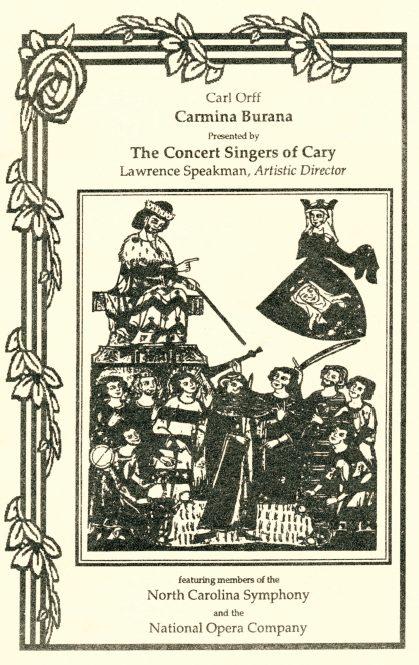
I sat down with a stack of my music collection that was about a foot high and sifted through various works before coming across German composer Carl Orff’s Carmina Burana. I had sung the work in dozens of performances during my years in Philadelphia with the Philadelphia Singers and the Pennsylvania Ballet. I’m sure that many of you are familiar with it and have sung it as well. It works well in a concert setting. The only problem was that the orchestra costs were well beyond what we could afford so I pivoted to another version that was written for two grand pianos with the same massive percussion section staffed by six players. Bert Fox joined Sarah Rogers, our regular accompanist to play the piano parts. We provided soloists using a combination of two professionals residing in Raleigh with the National Opera Company, as well as Sharyn Stith, Barbara Brown, and Kim Lemieux who were members of the Concert Singers. The percussion section was made up of NC Symphony players and other contract players.
Once we had everything in place I realized that our first season was made up of three programs of great diversity that would be a great first step in fulfilling our mission statement about all styles and traditions. This left a great deal of space in between to explore great choral music from any place, people or time for years to come. The first program featured music that utilized the writings of the great American poet Robert Frost, the second, a Christian-centric holiday program performed at a local church, and the third built around bawdy texts that were written during the 11th-13th centuries by the Goliards (wandering scholars, medieval clerics and students known for their satirical and often crude songs –I’ll let Google and YouTube provide you with the details if you want the specifics).
The performance was held at the Herb Young Community Center, a venue that was never intended when designed to be a concert space. It was and still is a gymnasium, but it served our purposes well at that time. It was good and it was bad.
First the good… logistics. The moveable bleachers provided adequate space and sightlines for a large choir. There were no barriers for setting up the chairs for the instrumentalists and the audience. There was total seating flexibility. It had a four-second reverb which helped the group sound like one hundred singers even though there were only sixty-three.
Now the bad… the lighting was poor and institutional looking. While the long reverb resonated the sound, the price paid was the total destruction of consonants and any other form of articulation. We would have been hard pressed to perform music there that was highly rhythmic or fast in tempo without it sounding like mud to the listener.
The Herb Young Center did, however, serve our needs as a civic facility that was in the center of town, had plenty of parking and was large enough to accommodate large scale performances. Most importantly, we could do a work like Carmina Burana there which content wise would have been impossible to do in any of the area sacred spaces.
The performance was well attended and gave us additional exposure to the business community and the Cary region. The singers gave their best performance to date. The chorus planned a post-concert reception advertising “Tuna and Slaw!”, a play on words from the text of Carmina Burana.
Click here to view the program for the Carmina Burana concert
Next up: ‘Chapter 4-The Invite That Turbocharged Everything’

The Concert Singers of Cary
Cary Arts Center
101 Dry Avenue
Cary, NC 27511-3312
910-242-4314

The Concert Singers of Cary have earned a Silver Seal from Candid.
Get to know us better
Contact Us:
We're a proud member of the Cary Chamber of Commerce, Chorus America, The Heart of Cary Association, and ArtsNC.


Concert Singers of Cary is supported by United Arts Council of Raleigh and Wake County as well as the N.C. Arts Council, a division of the Department of Natural and Cultural Resources